
Amid Big Tech’s enormous financial contributions to Trump – more than $1 billion in inauguration donations, super PACs, lobbying, and payments to Trump’s private businesses – his administration has pushed Big Tech’s agenda around the world, using tariff threats and secretive trade negotiations to roll back critical regulation of the digital ecosystem.
In January 2025, as part of his America First Trade Policy, President Trump directed the office of the U.S. Trade Representative (USTR) to compile a report on “unfair trade practices by other countries” and recommend appropriate remedial action. Big Tech companies and their lobbyists responded to the USTR’s notice for public comment, pointing out a host of other countries’ digital sector laws – both proposed and enacted – that might affect their profits. Based on these comments, the USTR submitted a report to President Trump on April 1, 2025, leading to the announcement of “reciprocal tariffs” on April 2, 2025.
Unfortunately, the USTR never released the report to the public, instead opting to publish a short summary. A Freedom of Information Act request for this document is pending. In the absence of the report that supposedly justified sweeping tariffs and secretive negotiations to avoid them, this analysis looks to the comments that industry submitted to inform the administration’s trade agenda.
This map provides an indicative list of digital economy-related regulations and policies that Big Tech companies and their lobbyists are eager for the U.S. government to target. There are certainly additional policies in a number of countries that may be targeted by the tech industry and U.S. trade negotiators. This map is based only on policies implicated in comments submitted within the 30-day window to the USTR by the Telecommunications Industry Association (TIA), U.S. Chamber of Commerce (USCoC), the Coalition of Service Industries (CSI), Internet Infrastructure Coalition (IIC), Computer and Communications Industry Association (CCIA), and the Consumer Technology Association (CTA). These trade associations and lobby groups represent tech giants including Google, Microsoft, Amazon, Facebook, and IBM, amongst others.
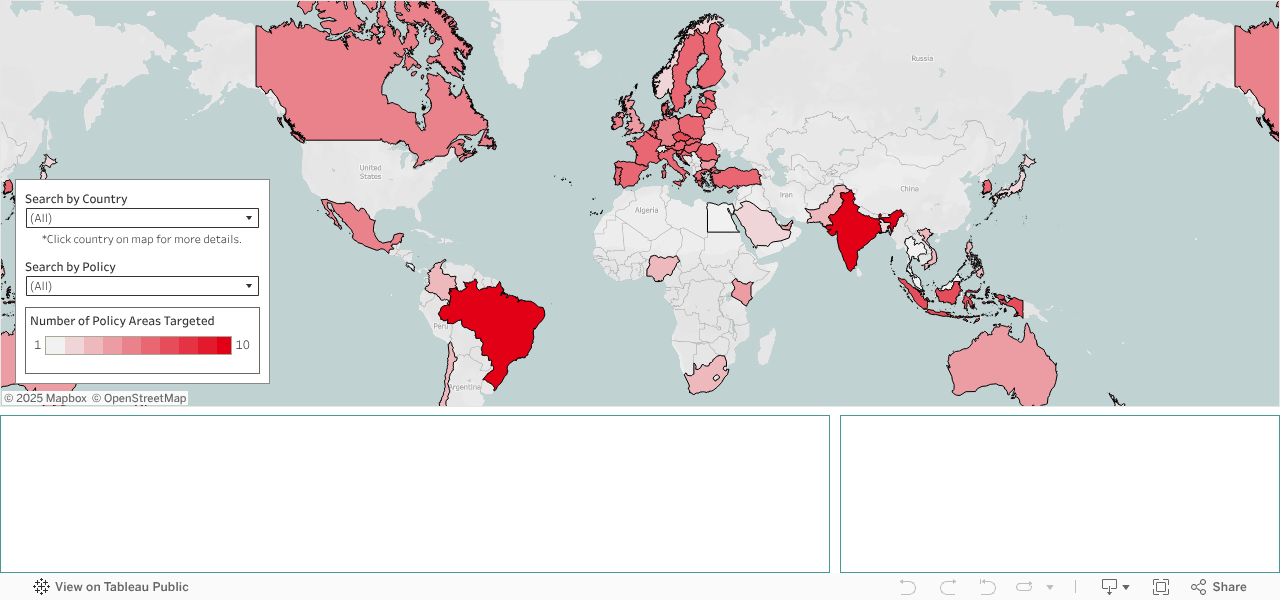
Some of the regulations referred to here have already been the subject of negotiations – for instance, the EU and Canada appear to have agreed to revoke proposed digital services taxes.
Several countries appear to have made concessions by pausing enforcement of digital economy-related regulations in advance of negotiations with the U.S. government. For example, India has withdrawn its “equalization levy,” a tax on advertising revenues of Big Tech companies, while Australia appears to be slow-walking enforcement of its news media bargaining code. None of these concessions has satisfied Trump, and these countries continue to face pressure to further deregulate or face additional tariffs.
Big Tech's Targets
Anti-monopoly laws: A number of jurisdictions are attempting to create fairer and more competitive digital ecosystems by implementing specific digital sector related competition regulation. This could take the form of ex ante regulation aimed at preventing dominant digital entities from engaging in particularly harmful behaviour. However, tech companies (wrongly) insist that such regulations are discriminatory, despite being neutral in their application. See for example, International Preemption by “Trade” Agreement”: Big Tech’s Ploy to Undermine Privacy, AI Accountability and Anti-Monopoly Practices, Rethink Trade, 2023
Source code disclosure: One of the ways in which transparency of AI and other digital systems can be enhanced and harm prevented is by enabling regulators and independent researchers to access source code. This is opposed by Big Tech companies, thereby reducing accountability of complex AI and other systems. See for example, Source Code Disclosures and Free Trade Agreements, Digital Trade Alliance, 2023
Privacy and Data protection: The importance of the data economy has led to a number of jurisdictions implementing privacy and data protection regulations that regulate how companies can process, store, and export personal data. A number of countries are also attempting to regulate the processing of non-personal data to ensure fairness in the digital economy and development of local tech ecosystems.
AI regulations: The growth of the AI industry has led to a number of jurisdictions seeking to implement regulations to govern the development and deployment of AI systems. Big Tech companies are seeking to limit the ways in which AI is regulated to reduce their compliance costs and oversight.
Regulation of electronic payments: Several countries have sought to implement rules on electronic payments, including in the context of security, data transfer, and other areas.
Restrictions on free cross-border data flows: Many countries implement restrictions on free cross-border data flows for reasons of national sovereignty, to protect personal data from being transferred to jurisdictions with low privacy standards, to enable regulators to access data, and to aid in local economic development. See for example, Cross-Border Data Flows and Free Trade Agreements, Digital Trade Alliance, 2024
Revenue sharing: Several jurisdictions are seeking to prevent the cannibalisation of domestic industries (such as publishing and content production) by large streaming or other digital services. A number of countries have also sought to introduce regulations that would require large technology companies and platforms to contribute towards network development, including by compensating telecom service providers.
DSTs and other taxes: Many countries are unable to appropriately levy income tax on Big Tech companies as these companies do not have a physical presence within their borders. Instead, they use Digital Services Taxes (DSTs) to ensure that these companies pay tax within their jurisdictions. Others implement some form of VAT, customs duties, etc., to increase their tax base. See for example, Understanding Digital Services Taxes, Public Citizen, 2025
Domestic production and import substitution: Several countries have sought to support the growth and development of domestic industries (and address balance of payments problems) by implementing regulations that support the use of domestically manufactured tech equipment.
Local testing and certification: Many countries require imported tech equipment to be tested for safety and adherence to local regulations prior to deployment.
Cloud service regulations: A number of countries have implemented regulations that seek to implement licensing or other regulations on cloud service providers. A number of countries have also sought to ensure that cloud services used by public or government authorities are appropriately certified for security reasons, while also limiting their ability to take data offshore.
*The map reproduces complaints made against various regulations and policies by American industry. It does not represent Public Citizen’s view on the quality of the regulations and policies. Policies in China and Russia have also been excluded from the map. European Union (EU) policies have been included amongst the policies of its constituent members. A list of the specific policies included in the map above can be viewed here.